
April 21, 2026
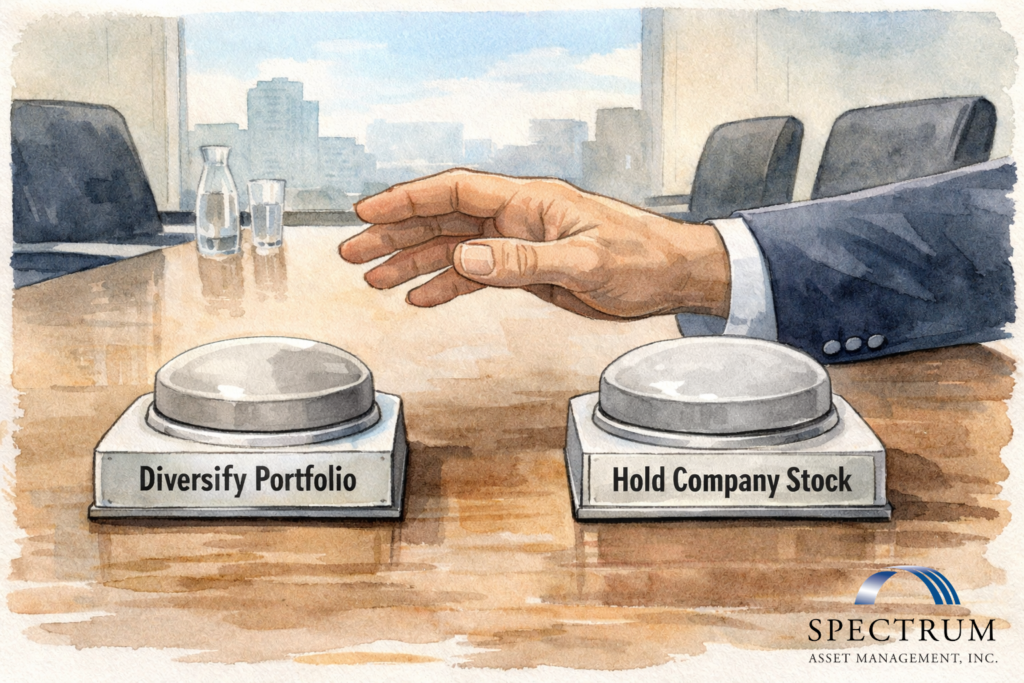
You know that diversifying company stock is rational. Yet you hesitate to reduce exposure.
That tension is not a knowledge gap. It is behavioral.
For public company executives with significant RSUs, options, or ESPP exposure, one of the hardest portfolio decisions is often the simplest one on paper: sell down concentration.
Diversification isn’t technically complex, it’s psychologically expensive.
Why This Matters More Than You Think
Concentrated stock risk is rarely about volatility alone. It’s about correlated exposure:
- Your income depends on the company
- Your career trajectory depends on the company
- Your wealth depends on the company
When all three point in the same direction, a single outcome can impact your entire financial life.
Many executives delay diversification not because they disagree with it, but because it feels wrong in the moment.
That feeling is predictable. And it has consequences.
Why Does Diversification Feel Wrong?
1. “I have an informational edge”
You are closer to the business than the market.
That proximity creates a sense of control:
“I understand this company better than outside investors.”
Reality:
- You understand operations, not stock pricing dynamics
- Markets price in aggregated expectations, not internal perspective
- Even insiders systematically overestimate their predictive advantage
Planning implication: Familiarity ≠ diversification strategy.
2. “Selling feels like disloyalty”
Executives often equate selling stock with signaling doubt.
“What message does this send?”
Reality:
- Diversification is personal financial risk management, not corporate judgment
- Boards and compensation committees expect executives to manage concentration risk
Planning implication: Your financial responsibility to your household is separate from your role inside the company.
3. “What if I sell and it keeps going up?”
This is the dominant emotional driver.
“I’ll regret selling more than I’ll regret holding.”
This is classic asymmetric regret bias:
- Gains missed feel worse than losses avoided with diversification
Reality:
- Concentration risk is not about maximizing upside
- It’s about avoiding irreversible downside
Planning implication: The goal is durability of wealth, not perfect timing.
4. “This stock built my wealth”
Your company stock is tied to your success story.
Diversification/selling feels like breaking that narrative.
Reality:
- What built your wealth is not always what preserves it
- Transition phases require different strategies than accumulation phases
Planning implication: Portfolio strategy must evolve with net worth.
Questions to Ask When Considering Holding vs. Diversifying
A simple list of questions for executives deciding how to act:
1. Exposure Mapping
- What % of your net worth is tied to one company?
- Include unvested equity and future grants
2. Dependency Check
- Is your income, bonus, and equity all linked to the same outcome?
3. Downside Scenario
- What happens if the stock drops 40–60%?
- Does it change your retirement timeline, lifestyle, or optionality?
4. Tax Awareness
- What is your embedded gain?
- Can diversification be staged across tax years or events?
5. Transition Plan
- What is your systematic path from concentrated to diversified?
- Not “if,” but “how and when”
Key insight: Diversification is not a trade. It’s a process.
Practical Mistakes to Avoid
1. Waiting for a “better price”
This turns risk management diversification into market timing.
2. Treating RSUs as “not real money yet”
They are compensation. Their value is already part of your financial picture.
3. Ignoring tax sequencing
Poorly timed sales can create avoidable tax drag.
Well-structured transitions can materially improve after-tax outcomes.
4. Making all-or-nothing decisions
Executives often think in extremes:
- Sell everything
- Sell nothing
The optimal path to diversification is often gradual and rules-based
5. Letting recent performance dictate strategy
Strong performance increases concentration risk—not reduces it.
What This Means for You
If diversification feels uncomfortable, that’s not a signal to avoid it. It’s a signal that you’re encountering a known behavioral friction point.
The goal is not to eliminate that discomfort. It’s to design around it with structure and discipline.
For most executives, the right next step is not a drastic move. It’s defining a clear, tax-aware transition strategy that reduces exposure over time without relying on emotion or timing.
The decision is not whether diversification is correct.
It’s whether you’re willing to act on it despite how it feels.
Have questions about your own situation? Feel free to Contact Spectrum Asset Management
Disclaimer: This material is for informational and educational purposes only and should not be construed as investment, legal, or tax advice. All investing involves risk, including the potential loss of principal. Consult your financial, legal, and tax professionals regarding your personal circumstances. Nothing herein constitutes an offer to enter into an advisory relationship. Spectrum Asset Management, Inc. (SAM) is an SEC-registered investment adviser headquartered in Newport Beach, California. SAM is not affiliated with any other firm using a similar name. Nothing herein constitutes an offer to enter into an advisory relationship.
*:Third-Party Website Disclosure: Links to third-party websites are provided for informational purposes only. Spectrum Asset Management, Inc. does not control or endorse the content of external sites and is not responsible for their accuracy or completeness.