
March 17, 2025
How much of a portfolio should be in one stock is a question that many executives eventually face, often after their company stock has performed well.
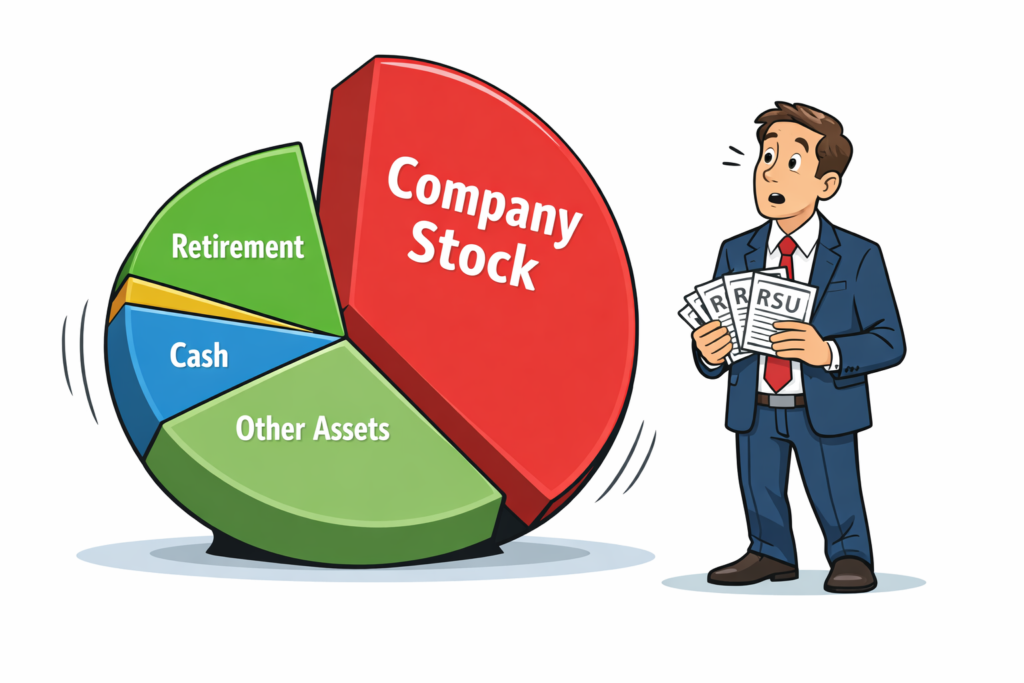
For leaders receiving RSUs and other forms of equity compensation, employer shares can quietly grow into the largest asset on their balance sheet. Multiple grant cycles, share price appreciation, and long tenure at a public company can significantly increase concentration in a single stock.
When that happens, the conversation shifts from compensation to risk management.
How Employer Stock Concentration Develops
Large positions in employer stock rarely happen overnight. Most often, concentration builds gradually over time.
A common pattern may include:
- Annual RSU grants vesting over multiple years
- Earlier grants increasing in value as the stock price rises
- Holding vested shares due to taxes or trading window restrictions
- New equity awards continuing to add exposure
After 10 to 15 years at a successful company, it is not uncommon for employer stock to represent 30%, 40%, or even more of total net worth.
At those levels, executives may begin evaluating potential concentrated stock risk, particularly when both compensation and portfolio value depend on the same company.
A Practical Way to Think About Single-Stock Exposure
When evaluating how much portfolio should be one stock, many executives begin by looking at their overall balance sheet.
The key question is not simply portfolio allocation. It is total financial exposure to one company.
For an executive, the a single company may influence:
- Salary, bonuses, and career trajectory
- Current stock holdings from vested grants
- Future equity compensation awards
- Retirement assets tied to company shares
This combined exposure is why single-stock concentration can become a meaningful planning issue.
Reviewing Concentration Over Time
There is no universal threshold that determines how much employer stock is appropriate for every executive.
Instead, many professionals evaluate concentration in the context of overall financial planning goals. Over time, that review may include liquidity needs, tax considerations, vesting schedules, and long-term diversification objectives.
For executives whose wealth has grown alongside their company, periodically revisiting how much portfolio should be one stock can help ensure their portfolio structure evolves as their career and net worth grow.
Curious how much of your net worth should be in employer stock? Contact us to learn more about our advisory services.
–
Disclaimer: This material is for informational and educational purposes only and should not be construed as investment, legal, or tax advice. All investing involves risk, including the potential loss of principal. Consult your financial, legal, and tax professionals regarding your personal circumstances.
Third-Party Website Disclosure: Links to third-party websites are provided for informational purposes only. Spectrum Asset Management, Inc. does not control or endorse the content of external sites and is not responsible for their accuracy or completeness.