
March 24, 2026
Executives receiving equity compensation often face a common concern: What to do with newly vested RSUs.
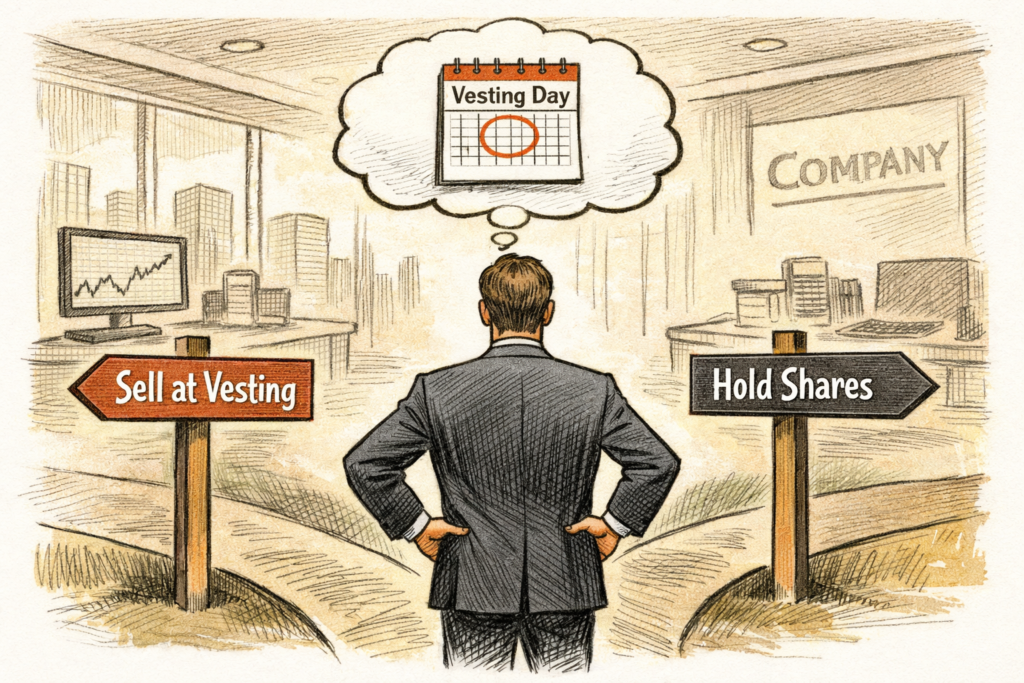
Hold? Sell? The choice may seem simple, but it directly affects taxes, portfolio concentration, and overall financial exposure.
At vesting, RSUs shift from a future benefit into taxable income and investable assets. That moment creates a decision point, not about the grant itself, but about what role those shares should play in your broader financial picture. For many, this is one of the few times where compensation, tax timing, and portfolio construction intersect all at once.
Understanding the Tax Impact
When RSUs vest, their value is taxed as ordinary income, regardless of whether shares are sold. This creates an immediate and unavoidable tax obligation, often accompanied by automatic share withholding to cover a portion of that liability.
However, withholding may not fully satisfy the total tax owed, particularly for executives in higher tax brackets. This can require additional planning around estimated payments or cash reserves.
If shares are held, any future price movement results in capital gains or losses. This means the initial income tax is already locked in, while additional value remains exposed to market changes. These mechanics make RSU taxation a central factor in evaluating next steps, especially when multiple vesting events occur throughout the year.
Evaluating Concentration Risk When Deciding What To Do With Vested RSUs
For many executives, employer equity already represents a large portion of both income and net worth. Holding vested shares can further increase concentrated stock risk, sometimes gradually and without a clear trigger point.
This can:
- Increase exposure to a single company’s performance
- Tie personal wealth more closely to employment outcomes
- Reduce diversification across the portfolio
- Limit flexibility during periods of volatility
Over time, this type of concentration can build across RSUs, stock options, and other equity grants. Looking at total exposure, rather than individual grants, can provide a more accurate picture of risk.
Aligning What To Do With Vested RSUs With Your Broader Financial Strategy
The decision to sell RSU at vesting or hold depends on how those shares fit into your overall financial structure.
Some executives prioritize reducing concentration and creating liquidity to support lifestyle needs, tax obligations, or other investments. Others may choose to hold shares when employer stock represents a smaller portion of net worth or when liquidity is not an immediate concern.
Timing also plays a role. Vesting schedules, blackout windows, and trading plans can all influence what actions are possible and when. Incorporating these constraints into equity compensation planning can help avoid reactive decisions.
Rather than treating each vesting event as a one-off decision, many executives benefit from a consistent framework that evaluates tax exposure, concentration levels, and cash flow needs together. This approach can provide more clarity and reduce uncertainty as equity compensation continues to accumulate.
Weighing the decision of what to do with vested RSUs? Contact Spectrum Asset Management
–
Disclaimer: This material is for informational and educational purposes only and should not be construed as investment, legal, or tax advice. All investing involves risk, including the potential loss of principal. Consult your financial, legal, and tax professionals regarding your personal circumstances. Nothing herein constitutes an offer to enter into an advisory relationship. Spectrum Asset Management, Inc. (SAM) is an SEC-registered investment adviser headquartered in Newport Beach, California. SAM is not affiliated with any other firm using a similar name.
Third-Party Website Disclosure: Links to third-party websites are provided for informational purposes only. Spectrum Asset Management, Inc. does not control or endorse the content of external sites and is not responsible for their accuracy or completeness.