March 3, 2026
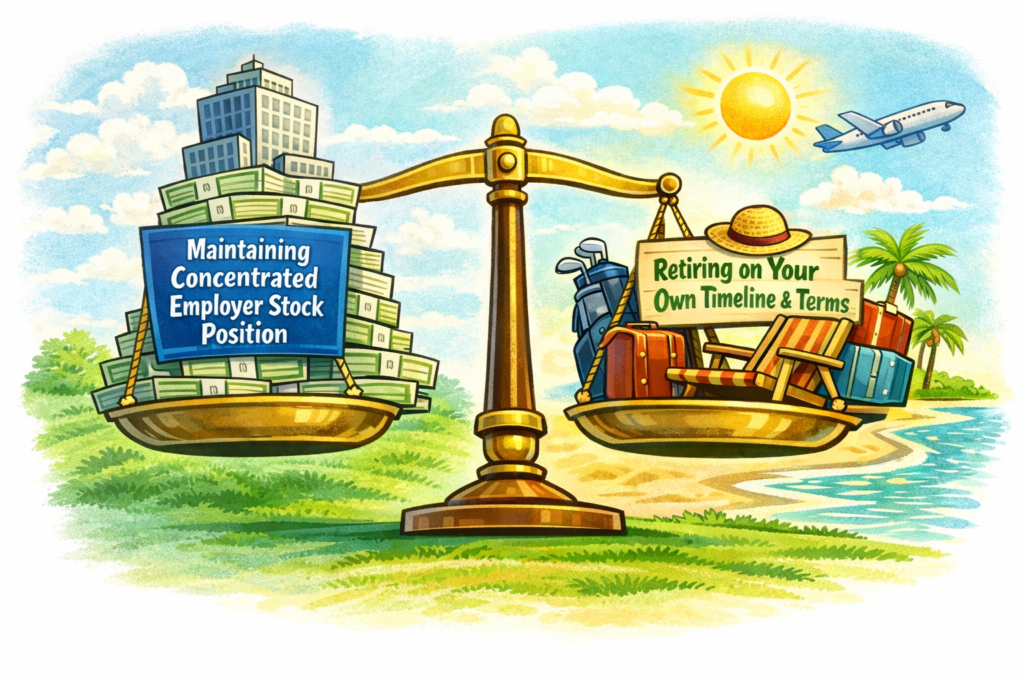
For many coporate executives, concentrated stock risk and retirement timing are closely connected. When a substantial portion of net worth is tied to employer equity, stock performance may influence not only portfolio values, but also when retirement feels financially viable.
Executive compensation packages often layer salary, annual incentives, RSUs, and performance shares on top of one another. Over time, this can create meaningful exposure to a single company’s results. Not just for current income, but for long-term wealth accumulation.
As retirement approaches, that overlap can become more consequential.
Understanding Human Capital Risk and Concentrated Stock Risk
Human capital risk reflects reliance on one employer for income, benefits, and future earning potential. At the executive level, compensation is frequently linked to company performance, which can increase correlation between employment stability and equity value.
In periods of volatility, stock declines may coincide with organizational restructuring or compensation pressure. This dual exposure can affect short-term cash flow and long-term asset values simultaneously.
When retirement assets are heavily concentrated, market performance may begin to influence personal career decisions.
How Employer Equity Exposure Affects Retirement Timing
Employer equity exposure often grows gradually through ongoing vesting and retained shares. What begins as a manageable allocation can become a significant percentage of total net worth.
Executives may find that:
- A large portion of projected retirement assets is tied to one stock
- Recent stock performance materially affects retirement readiness calculations
- Delaying retirement may feel necessary after a market downturn
- Strong performance may accelerate financial independence assumptions
In this way, retirement timing can become partially dependent on stock performance rather than personal preference alone.
Integrating Risk Management Strategies into Retirement Planning
Thoughtful risk management strategies may help executives evaluate how equity concentration aligns with desired retirement timelines.
This can include liquidity modeling, tax-aware diversification within permitted trading windows, and scenario analysis under different market conditions. These exercises often play a central role in retirement planning discussions when concentrated equity represents a significant share of wealth.
The appropriate approach depends on goals, risk tolerance, and broader financial circumstances. Understanding how career risk and portfolio risk intersect can provide greater clarity when planning the transition to retirement.
If you would like to discuss your specific situation, you may Contact Spectrum Asset Management to learn more about our Wealth Management services.
Disclaimer: This material is for informational and educational purposes only and should not be construed as personalized investment, legal, or tax advice, or as a recommendation of any specific security or strategy. All investing involves risk, including the potential loss of principal. Consult your financial, legal, and tax professionals regarding your personal circumstances.